Switch 2 Controversy Defines Doug Bowser’s Retirement as Nintendo of America President With Gamers Mocking His Infamous 'Go Buy a Switch One' Quote
Devon Pritchard now steps into the role as Nintendo reshuffles its U.S. leadership.

Summary
- Doug Bowser will retire as president of Nintendo of America on December 31, 2025, after six years leading the company.
- He’ll be replaced by Devon Pritchard as president and Satoru Shibata as CEO, reshaping Nintendo’s U.S. leadership team.
- Bowser’s legacy is split, praised for the Switch 2 launch, but criticized for rising prices and his infamous ‘buy a Switch One’ remark.
When Nintendo of America confirmed that its president and chief operating officer, Doug Bowser, would step down at the end of 2025, the announcement was delivered with the sort of corporate formality that typically accompanies leadership changes.
Buried inside a personnel update rather than spotlighted in celebratory fanfare, the news landed with an oddly muted tone for a figure who, for six years, stood at the front of one of the most recognizable brands in entertainment.
Related
Bowser, a veteran executive who joined Nintendo in 2015 after years at Electronic Arts, will vacate his role on December 31, 2025.
He will be succeeded by Devon Pritchard, a longtime company insider, while Satoru Shibata, the former head of Nintendo of Europe, will step in as chief executive officer of Nintendo of America.
In his statement, Bowser called his tenure “the honor of a lifetime,” highlighting the company’s growth and consumer experiences during his leadership.
Tap the image below to zoom in 👇
A Low-Key Exit
In an industry accustomed to farewells full of nostalgia and memes, Bowser’s exit felt almost clinical.
His predecessor, Reggie Fils-Aimé, received a hero’s send-off in 2019, complete with viral tributes and warm public acknowledgment.
Bowser, by contrast, received a “short release” and little in the way of official recognition from Nintendo’s own channels.
This subdued handling raised eyebrows among commentators and fans, who noted the absence of celebratory tweets or highlight reels.
Instead, the announcement circulated through business wires and Bowser’s personal post.
For some observers, it reflected a shift in tone at Nintendo of America, less personality-driven and more tightly corporate.
Timing and Speculation
On the surface, Bowser’s departure arrives at a logical milestone. Nintendo launched its much-anticipated Switch 2 earlier this year, and early numbers positioned it as one of the fastest-selling consoles on record.
Exiting while on top, at least in terms of headline sales, fits the narrative of an executive bowing out at the right moment.
Yet speculation persists. The Switch 2, while moving millions of units, has been dogged by criticism over price increases, supply chain quirks, and what many gamers see as a decline in goodwill.
Reports of consoles sitting on U.S. shelves longer than expected have sparked questions about whether demand matched Nintendo’s lofty expectations.
Critics point to Bowser’s leadership style, shaped during his years at Electronic Arts, as one possible source of friction.
EA’s reputation for aggressive monetization and controversial practices followed him to Nintendo in the minds of skeptical fans.
Some suggest that Japan’s headquarters may have preferred a course correction, especially if sales momentum falters in Western markets.
The “Quote” That Stuck
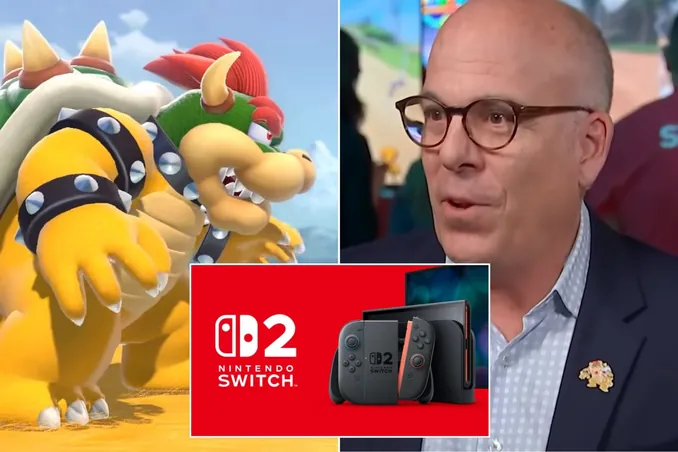
Bowser’s tenure will almost certainly be remembered less for the launch numbers and more for a single statement that went viral: his suggestion that consumers unable to afford the new Switch 2 should “go and buy the Nintendo Switch One” instead.
“We recognize there are some people that may not be able to afford [the Switch 2’s] price point. That’s why we wanted to make the other Switch platforms available, so [people] still have an opportunity to come into our gaming universe, be a part of these characters in these worlds, and see value, if you will, in whatever rung of the platform they come in.” - Doug Bowser in a interview for CBC
It was a comment meant, perhaps, as a practical fallback option, but it landed with the sting of indifference.
To many, it symbolized a shift from Nintendo’s once-whimsical image to a company perceived as increasingly rigid, profit-focused, and dismissive of its audience.
The remark has already earned Bowser unflattering comparisons to Don Mattrick, the former Microsoft executive whose tone-deaf comments about the Xbox One haunted his career.
Online, Bowser’s name became shorthand for Nintendo’s more corporate and less consumer-friendly era.
Legacy
For defenders, Bowser’s resume is hard to dismiss. Under his leadership, the original Switch continued to thrive deep into its life cycle, and the Switch 2 launched to record-breaking numbers.
From a shareholder perspective, Bowser delivered stability and growth. Nintendo stock even ticked upward in Tokyo following the announcement of his departure, though analysts caution against drawing a direct line.
For critics, however, Bowser’s years coincided with what they describe as the erosion of Nintendo’s charm.
Rising hardware and software prices, aggressive legal tactics against fan projects and community events, and the perception of indifference toward Western audiences fueled resentment.
The Switch 2’s launch encapsulated these tensions. Though commercially successful, it was shadowed by online discourse that framed Nintendo as greedy and out of touch.
Unlike the relatively harmless ribbing Nintendo endured during the Wii U years, the tone shifted toward outright hostility in corners of the gaming community.
Successor Challenges
Incoming president Devon Pritchard inherits both opportunity and burden.
A 19-year Nintendo veteran, Pritchard is described as deeply familiar with the company’s operations and culture.
But she will need to navigate an American market that has grown more skeptical of Nintendo’s pricing strategies and legal aggressiveness.
Joining her at the top is Satoru Shibata, who brings experience as Nintendo of Europe’s president, where he appeared in Nintendo Direct presentations alongside Reggie Fils-Aimé and the late Satoru Iwata.
His return to a frontline role may signal an attempt to restore some of the personal connection that fans feel has been lost.
Comparisons to the Past
The contrast with Reggie looms large. Fils-Aimé embodied a balance of executive polish and fan accessibility, becoming a meme-worthy figure who embraced Nintendo’s playful identity.
Bowser, despite his fitting name, never quite filled those shoes. Instead, his tenure was marked by efficiency, cautious communication, and a sense that Nintendo of America had less latitude to chart its own course.
Industry watchers argue that this is less about Bowser personally and more about structural changes at Nintendo.
The company’s U.S. arm has long been subordinate to Kyoto, but the era of bold public personalities may be over, replaced by a quieter, more tightly managed approach.
For all the debate, Bowser leaves behind a Nintendo that remains financially strong and culturally relevant.
The Switch 2’s long-term trajectory will shape how his exit is ultimately judged. If the console maintains momentum, his tenure may be remembered as a period of stability and growth.
If it falters, a lot of people will cite his leadership as the beginning of Nintendo’s decline in the West.
Either way, Bowser departs with a complicated legacy. He was the executive who oversaw Nintendo’s most successful hardware transition in decades, yet also the figure whose name became shorthand for rising prices and dwindling goodwill.
As one commentator put it in a recent retrospective,
“The face people will remember when Nintendo crossed the line from beloved to resented isn’t Shuntaro Furukawa’s in Japan, it’s Bowser’s in America”.
Doug Bowser retirement statement
“One of my earliest video game experiences was playing the arcade version of Donkey Kong.
Since that time, all things Nintendo have continued to be a passion for both me and my family. Leading Nintendo of America has been the honor of a lifetime, and I am proud of what our team has accomplished in both business results and the experiences we’ve created for consumers.
Now it’s time for the next generation of leadership and Devon’s track record speaks for itself. She is an exceptional leader, and her promotion is a testament to her strong performance and strategic contributions to the company’s growth. I have full confidence that she will guide the company to even greater heights.”
Got a tip for us? Email: [email protected]. Did you find an error in this article? Email: [email protected].
The iconic sequel to Banjo-Kazooie is launching on October 25, now with widescreen support.